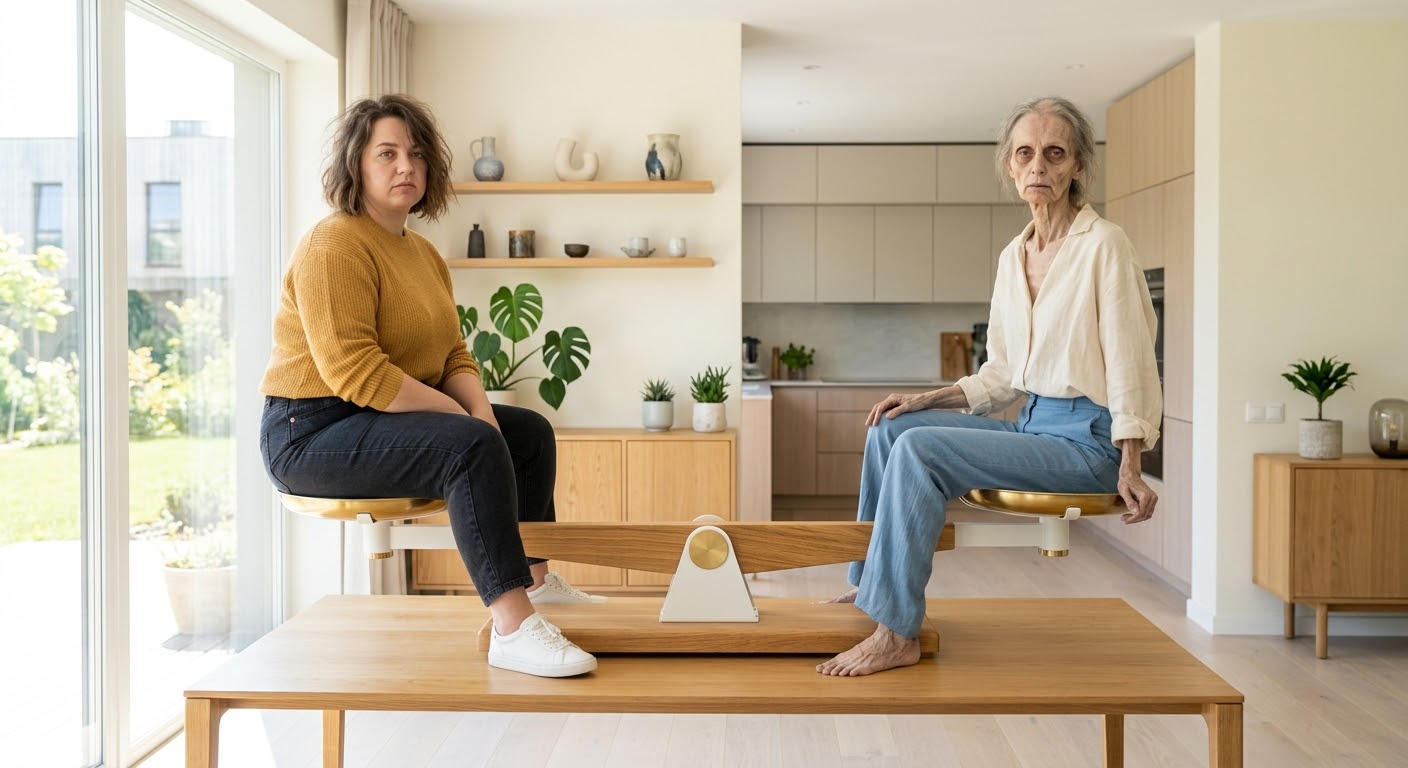
Picture two people. One has been working out at home for 30 to 40 minutes at a time for six months. No diets, no counting every calorie, and you can already see the muscle definition. The other has been going to the gym for ten years, lifts much heavier weights and watches what they eat, yet their body looks much the same.
How does that happen? Is it magic, genetics, or were some people just lucky enough to be born with their “dream body”?
For starters, we naturally have different body proportions. We also carry muscle and fat in different places.
What can somatotypes tell us?
The somatotype model is one way to describe someone’s build. It looks at three components:
- Ectomorphic refers to long, slender proportions. If there’s little fat under the skin, the muscles can show even without intense training.
- Mesomorphic describes a sturdier, more muscular build. It’s what people often call an “athletic build”, though you can’t tell how quickly someone builds muscle just by looking at them.
- Endomorphic refers to a higher proportion of body fat and is often associated with a rounder build. That doesn’t mean someone can’t have well-defined muscles.
Here’s the catch: all three traits can show up in the same person. A somatotype describes your build. It doesn’t tell you what “type of metabolism” you have, how fast you’ll build muscle or what results you’ll get.
Now here’s where it gets a little more interesting.
The Indian tradition of Ayurveda has its own way of talking about differences between people: the three doshas, vata, pitta and kapha. It’s a traditional idea, not a scientific way to classify body shape or metabolism. What interests me is the thought behind it: people are different, and one yardstick doesn’t work for everyone.
Why can the same workouts give such different results?
Genetics plays a part in how we look and how we respond to exercise. Body proportions, the shape of our muscles and where we carry fat all matter. So two people can gain a similar amount of muscle and still look quite different.
The gains themselves can vary, too. In one study of strength training, people followed the same programme, but the changes in muscle size varied considerably.
Now let’s talk about men and women. On average, men start with more muscle mass. So they can gain more in absolute terms, even when their muscles grow by roughly the same percentage as women’s.
My husband, for example, can skip training for a whole year and then turn into the Terminator in two months. You can see every muscle, as if someone drew them in one by one. Then he goes straight back to his computer for another holiday of indefinite length, saying, “I’ll be back.” 😅
I’m certainly not saying every man will get the same result in two months. Even among men who train regularly, lift just as much and put in plenty of effort, some see changes sooner than others.
And then there’s me. Some days I teach five sessions. I work five hours a day, five days a week, sometimes more. And I still only see my own muscle definition in certain lighting. And only if I’m not a bit puffy, because my cycle doesn’t take time off. 😢
And here’s the best part: one of my clients has been training with me three times a week for just six months, and her muscles are much more defined than mine. 😅
Five hours of moving around isn’t the same as five hours of training that makes your muscles grow. And how well you can see those muscles also depends on the layer of fat under your skin, water retention, anatomy and even the lighting.
So is it all down to genetics?
Of course not! We start in different places, but training can still change our bodies.
Going to the gym for ten years doesn’t mean you’ve been making progress for ten years. You can spend years doing the same exercises with the same weights. Or you can push so hard every session that you never quite recover before the next one. A good home workout programme, on the other hand, can get you great results.
It’s simple: don’t compare your physiology to someone else’s progress photo.
Even if you’re training side by side and doing the same exercises, you each have your own starting point. Constantly measuring your progress against someone else’s muscle definition is an exhausting game. Pay attention to what’s changed for you: which movements feel easier? Are you stronger? Can you keep going for longer?
You need your body to move, to live and to have the energy for the things you love. So don’t try to get someone else’s body. See what yours can do.